C-Arm Fluoroscopy Guide: 7 Essential OR Skills (Sterile Field, Positioning & Radiation Safety)
Introduction: The Rad Tech in the Operating Room
The operating room is one of the most challenging and rewarding environments a radiologic technologist can work in. Unlike the controlled, familiar setting of the radiology department, the OR presents unique obstacles: sterile fields that cannot be violated, cramped equipment positioning, high-stakes time pressure, and a surgical team that depends on your images in real time to guide their next move. One wrong positioning move or a moment of hesitation can delay a surgery or compromise sterility.
C-arm fluoroscopy provides real-time guidance for procedures ranging from orthopedic fixation and spine instrumentation to vascular interventions and image-guided injections. It can show anatomy, devices, and contrast flow without enlarging an operative exposure solely for visualization. Safe practice requires verified competency in the specific equipment, sterile-field workflow, procedure-specific positioning, image quality, and radiation protection.
This guide introduces surgical C-arm equipment, sterile-field workflow, positioning concepts, radiation safety, dose indicators, image-quality troubleshooting, and ARRT-style practice questions. It supplements—not replaces—supervised competency training, local protocols, laws, and manufacturer instructions.
ARRT Exam Insight
Fluoroscopic equipment, radiation protection, and mobile/surgical imaging appear in ARRT content specifications. ARRT does not promise a fixed number of C-arm questions; use the current specification for your discipline rather than relying on an unofficial question count.
C-Arm Equipment: Components and Controls
Before you step into the OR, you need to understand the machine itself. The C-arm is named for its distinctive C-shaped connecting arm that holds the X-ray tube on one end and the image receptor on the other. This design allows the arm to be rotated, angled, and swiveled around the patient without moving the patient or the surgical table.
Key Components of a Mobile C-Arm
- X-ray tube — Located at one end of the C-arm. Available focal-spot sizes and thermal ratings are model-specific; use the manufacturer specifications rather than assuming one focal-spot range.
- Image receptor — At the opposite end. Older units use an image intensifier (II); many newer units use flat-panel digital detectors. Flat panels generally provide wider dynamic range and less geometric distortion, but detector type alone does not guarantee a lower patient dose; dose depends on system design, settings, geometry, patient size, and the imaging task.
- C-arm arc — The curved connecting structure. Can be rotated in the orbital plane (around the C-shape), swung in the horizontal plane, or pivoted on the wheeled base.
- Control console — Usually mounted on the mobile cart. Available controls may include procedure/dose mode, pulse rate, kVp or mA, collimation, magnification/field of view, image processing, and acquisition; automatic dose-rate control manages some factors on many systems.
- Hand switch or foot switch — A dead-man exposure control: radiation should stop when pressure is released. Controls and selectable pulse rates vary by model; verify which pedal or switch activates fluoroscopy versus acquisition before the case.
- Monitors — One or more displays positioned for the operator and surgical team. Some systems have touch-screen interfaces and 3D reconstruction capabilities.
- Last-image hold (LIH) — Retains the most recent fluoroscopic image after the exposure control is released, allowing review without additional irradiation.
Image Intensifier vs Flat-Panel Detector
The type of image receptor on your C-arm significantly affects image quality, dose, and workflow. Here is how the two technologies compare:
| Feature | Image Intensifier (II) | Flat-Panel Detector (FPD) |
|---|---|---|
| Image characteristics | Good; geometric distortion can occur, especially toward edges | Little pincushion/S-distortion; performance remains system- and task-dependent |
| Receptor profile | Deep, bulky vacuum housing | Thinner panel; complete C-arm weight still varies by model |
| Dose efficiency | Conversion gain can decline with age | Often higher DQE, but patient dose is not predictably lower without comparing protocols |
| Distortion | Pincushion and magnetic S-distortion may be present | No II pincushion or S-distortion; other artifacts remain possible |
| Dynamic range | Narrower than many flat panels | Generally wider |
| Service life | Gain can degrade over time | Calibration drift, lag, and defective pixels can occur; not inherently stable for life |
| Cost/service | Purchase, service, calibration, and lifecycle costs are model- and contract-specific | |
Clinical Pearl
Both flat-panel and image-intensifier C-arms remain in service. Know the specific system: controls, field-of-view behavior, dose modes, image processing, quality-control checks, and draping method are model-specific.
Mobile C-Arm Fluoroscopy: Parts, Controls, Movements & Orientation
Before you can position a C-arm, you need to be able to name what you are looking at and predict what each control or movement will do. This section gives you a generic map to learn before you work with the equipment in a live case. Button layouts, movement names, axis conventions and available imaging modes are model-specific, so learn the functions here, then confirm the exact labels, limits and behaviour in your unit's instructions for use (IFU) and your site training before operating the system.
Labelled parts reference
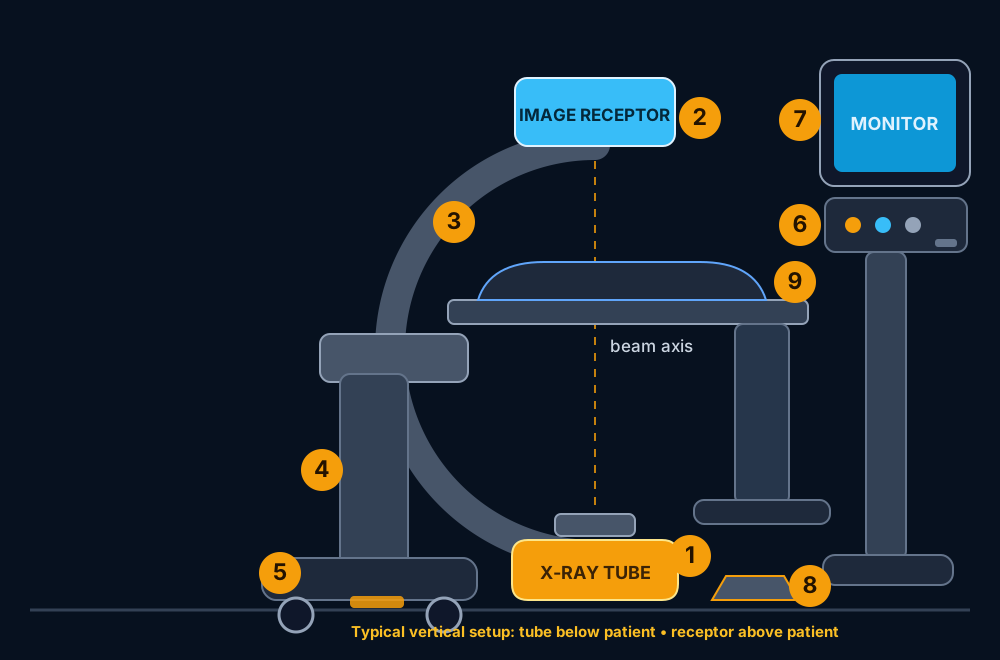
- X-ray tube and collimator — the tube produces the X-ray beam at one end of the arc; the collimator (beam-limiting device) restricts the irradiated field.
- Image receptor — positioned opposite the tube; this may be an image intensifier or a flat-panel detector, depending on the system.
- C-arm arc — the curved structure connecting the tube and receptor. Movement of the arc and its support changes the beam projection around the patient.
- Lifting column and support/carriage — supports the C-arm and, depending on the system, provides vertical travel, horizontal travel and rotational movements.
- Mobile base — wheels, steering and brakes; position and secure the unit according to the system IFU and site procedure before imaging.
- Control panel / console — the operator interface for functions such as fluoroscopy mode, pulse rate, collimation, field of view, image processing, acquisition and dose information. Controls may be located on the C-arm, monitor workstation, remote control, hand switch or footswitch depending on the system.
- Monitors — one or more displays for the operator and surgical team.
- Radiation activation control (footswitch shown) — fluoroscopy is commonly activated by a continuous-pressure hand or foot control; other pedals or buttons may be assigned to radiographic acquisition or additional modes depending on the system.
- Patient support/table (shown for context) — separate from most mobile C-arm units; the C-arm is positioned around the patient and table to obtain the required projection.
Geometry safety checkpoint: In a typical vertical setup, keep the X-ray tube below the patient when clinically practical, maximize the tube-to-patient distance, and position the image receptor as close to the patient as safely possible. This helps reduce patient entrance dose and scatter to staff.
What the controls do — and why it matters
| Control (function) | What it does | Why it matters to you |
|---|---|---|
| Fluoroscopy activation control (hand or foot) | Requires continuous operator pressure during fluoroscopy on compliant systems; in the U.S., 21 CFR 1020.32(c) requires continuous pressure for the entire fluoroscopic exposure. | Release the control as soon as real-time imaging is no longer needed. Footswitch assignments can vary, so confirm the system-specific function before use. |
| Fluoroscopy / dose-rate mode | Selects a fluoroscopic operating mode or target dose-rate program; the exact behavior is model-specific | Use the lowest clinically acceptable dose-rate setting that provides the information needed for the task, according to protocol. |
| Pulsed fluoroscopy (pulse rate) | Produces fluoroscopic images in pulses rather than as a continuous image stream | Lower pulse rates often reduce radiation output when other factors are comparable, but actual dose depends on the system's automatic response and selected technique. Use the lowest pulse rate that still provides adequate temporal information. |
| Last-image hold (LIH) | Keeps the last fluoroscopic image available after irradiation stops. | Lets the team review an image without continuing fluoroscopy. In the U.S., fluoroscopic equipment manufactured on or after June 10, 2006, must provide a means to display an LIH image. |
| Collimation | Restricts the X-ray field to the region of interest | Good collimation reduces the irradiated area and scatter and may improve image contrast. Collimate as tightly as the clinical task allows. |
| Field of view / magnification | Changes how much anatomy is displayed and the degree of electronic magnification | Magnification modes can increase dose on many fluoroscopic systems. Use the least magnification — or largest field of view — that still answers the clinical question. |
| Automatic brightness / dose-rate control (ABC / ADRC) | Automatically adjusts technique factors to maintain the detector signal or displayed image quality | Image brightness is not a direct dose indicator. The system may change kVp, mA, pulse width or other factors to maintain the image, so use the system's dose information rather than judging dose from screen brightness. |
| Image-processing controls (for example window/level, edge enhancement or image rotation) | Adjust how an acquired or stored image is displayed; available functions vary by system | Post-processing can improve display or orientation without repeating an exposure. Do not confuse display changes with changes in the X-ray beam or projection. |
| Dose display (air-kerma rate and cumulative air kerma) | Displays radiation-output information at the fluoroscopist's working position on systems where these metrics are provided or required. | These values are not the operator's personal dose and cumulative air kerma is not the same as peak skin dose. For U.S. C-arm fluoroscopes manufactured on or after June 10, 2006, the reference location is 15 cm from isocentre toward the X-ray source, or a manufacturer-specified point representing beam entry at the patient's skin. The display must be resettable before a new examination or procedure. |
| Brake / lock and steering controls | Secures or releases the base and/or individual C-arm movements, depending on the system | Confirm the correct brake or movement lock before imaging or repositioning. Movement controls and brake conventions are model-specific. |
Movements — and what each one changes
Movement names are not universal. Manufacturers may use terms such as orbital, angulation, rotation, swivel/pan, horizontal travel and vertical travel differently. Learn the movement axes below, then use the labels and movement indicators on your own system.
| Movement | What actually moves | Effect | Typical use |
|---|---|---|---|
| Vertical travel (up / down) | The lifting column raises or lowers the C-arm support. | Changes the height of the whole C-arm relative to the patient and table. It does not normally change the fixed source-to-receptor distance of the arc. | Align the beam with the anatomy, improve clearance, and optimize patient-to-source/receptor geometry. |
| Horizontal travel (in / out) | The horizontal support arm or carriage slides forward/backward. | Re-centres the imaging field relative to the patient without changing the angular projection. | Follow anatomy along a limb or spine, or centre the region of interest. |
| Orbital movement | The C-arm slides around its curved track around the patient. | Changes the tube–receptor angle around the patient in one rotational plane. | Move between different projections of the same anatomy, including AP-to-oblique/lateral-type positions depending on the system and patient position. |
| Angulation / angular movement | The C-arm rotates about the horizontal support-arm axis. | Changes beam direction in a second rotational plane, distinct from orbital motion on many mobile C-arms. | Fine-tune obliquity or cranial/caudal-type angulation according to the system geometry and procedure. |
| Swivel / pan | The support assembly turns around the vertical lifting column. | Repositions the C-arm in the horizontal plane without sliding the arc through its orbital track. | Fine positioning and clearance around the patient, table and surgical team. |
| Image rotate / flip (display control) | The displayed image is rotated or mirrored electronically; the C-arm itself does not move. | Changes display orientation only — it does not change the X-ray beam or the acquired projection. | Present the image in the orientation preferred by the operator or surgeon. |
Two habits that prevent common C-arm mistakes:
1. Release, announce, move, re-image when live guidance is not required. Stop fluoroscopy before routine repositioning whenever continuous visualization is not clinically necessary, communicate the movement to the team, then re-image. Some systems support specialized motorized or rotational acquisitions during irradiation; use those only when designed for the procedure and according to the IFU and site protocol.
2. Use non-radiation positioning aids when available. Use known system geometry, positioning marks, laser/light localizers, or virtual collimation/LIH tools if provided. Do not use fluoroscopy merely to search for anatomy when a non-radiation positioning method can accomplish the task.
Common mix-ups — error to correction
| The mistake | Why it happens | The correction |
|---|---|---|
| "I'll just touch the pedal to see where the tube is pointing." | The X-ray beam is invisible, so the live image can feel like the easiest positioning guide. | First use the system's non-radiation positioning aids and known geometry. If fluoroscopy is clinically needed to confirm position, use the shortest adequate fluoroscopic activation at the lowest clinically acceptable dose-rate setting, then use last-image hold for review. |
| "The image looks nicely bright, so the dose must be fine." | ABC/ADRC and image processing can keep display appearance relatively consistent while technique factors change. | Check the system's dose information and selected technique, not image brightness alone. Screen brightness is not a direct dose indication. |
| “I’ll keep the beam on while I reposition, even though live guidance is not needed.” | Real-time feedback can feel efficient, but unnecessary irradiation during ordinary repositioning adds exposure without adding useful information. | When live guidance is not clinically necessary, release fluoroscopy, communicate the move, reposition, then re-image. Specialized acquisitions that intentionally move the C-arm during irradiation are an exception and must follow the system IFU and site protocol. |
Source notes for this section
- U.S. FDA / eCFR — 21 CFR 1020.32: fluoroscopic equipment requirements
- IAEA — radiation protection guidance for fluoroscopy and image-guided procedures
- Siemens Healthineers — mobile C-arm hardware/movement training example
- Image Wisely — fluoroscopy dose optimization principles
Check yourself
1. The fluoroscopic image looks adequately bright. Can you assume the radiation dose rate is low?
- A. Yes — a bright image means the system is using very little radiation.
- B. Yes — as long as the image is not noisy.
- C. No — ABC/ADRC and image processing can keep the display looking similar while radiation output changes.
- D. No — but only when magnification is selected.
Answer: C. Display brightness is not a direct dose indicator. Automatic brightness or dose-rate control can change technique factors to maintain image appearance, so check the system's dose information and selected imaging mode rather than judging dose from brightness alone.
2. You need a different projection of the same anatomy. Which action changes the X-ray beam projection?
- A. Rotate or flip the image on the monitor.
- B. Increase the pulse rate.
- C. Change the C-arm's orbital/angulation angle around the patient, using the movement convention defined for that system.
- D. Change the monitor brightness.
Answer: C. A different projection requires a change in beam angle relative to the patient. Electronic image rotation or flipping changes display orientation only; pulse rate and monitor brightness do not change the projection.
Sterile Field Protocol: Essential Rules for OR Radiography
Maintaining the sterile field is a core patient-safety responsibility shared by the entire OR team. A contamination event can increase surgical-site-infection risk. The technologist should follow the facility's infection-prevention policy, the sterile team's direction, and the C-arm/drape manufacturer's instructions for use (IFU); these determine attire, traffic, draping, cleaning, and who may handle each part of the cover.
Before Entering the OR
- Wear required OR attire: Facility policy determines scrub attire, hair covering, mask use, footwear or shoe covers, and jewelry. Secure loose items and complete hand hygiene as required; shoe covers are not a universal substitute for appropriate OR footwear or environmental cleaning.
- Verify the plan: Review the procedure, patient identity, documented side/site, patient position, requested views, equipment compatibility, table clearance, and planned C-arm approach during the team briefing/time-out. Do not infer laterality from the schedule alone.
- Inspect the equipment: Complete the manufacturer/facility pre-use check, including brakes, collision clearance, cables, exposure switch, displays, dose settings, emergency stop, sterile covers, and required PPE. Perform test irradiation only under the approved quality-control procedure with the beam safely directed and personnel protected.
C-Arm Draping Procedure
Any nonsterile C-arm surface that will pass over, contact, or enter the sterile field must be isolated using the cover and method specified by the device/drape IFU and local policy. Cover designs differ (receptor-only, split, or full C-arm), so there is no single universal sequence:
- Plan and, where policy permits, pre-position the nonsterile unit before skin preparation and draping; confirm that the table, anesthesia equipment, lines, and patient will clear every planned motion.
- The circulating person opens the package without contaminating its contents. Sterile team members handle the sterile exterior; the nonsterile technologist handles the unit and the cover's nonsterile interior, exactly as the IFU assigns roles.
- Cover all surfaces that will cross the sterile boundary, remove trapped air if directed, and secure the cover without restricting ventilation, movement, collision sensors, the receptor face, or the tube port.
- Keep uncovered portions, cables, controls, and the base outside the sterile field. Never reach across the field or assume the underside/edge of a drape is sterile.
- If a cover tears, slips, touches a nonsterile surface, or sterility is uncertain, stop movement, announce the concern immediately, and let the sterile team determine corrective action (for example, redraping or replacing contaminated items).
Communicating with the Surgical Team
Clear communication with the surgeon and surgical team prevents positioning errors and breaks in sterility. Establish your role early: you control the C-arm, and you need to hear instructions clearly. Common communication protocols include:
- "Coming around" — Announcing when you are moving the C-arm into position so the surgical team can step back and protect the sterile field.
- "X-ray" or "fluoro on" — Use the facility's agreed warning immediately before irradiation so personnel can maximize distance and shielding; terminology and requirements are local.
- "X-ray off" — Confirm that the exposure switch has been released. Do not use “last image” as proof that radiation has stopped; verify the console's irradiation indicator and audible signal.
- Hand signals — In some ORs, the surgeon will use hand gestures to indicate desired C-arm angulation (e.g., tilt cranial or caudal, rotate left or right). Learn these signals before the case begins.
ARRT Exam Tip
Core sterile-field concept: Nonsterile equipment must not contact or pass over the sterile field unless the relevant surfaces are isolated as required by the IFU and local policy. A technologist should never silently “fix” suspected contamination: stop, announce it, and allow the sterile team to direct the response.
C-Arm Positioning for Common Orthopedic and General Surgeries
Different procedures require different orientations. The examples below are planning concepts, not prescriptions: fracture pattern, implant system, patient anatomy, table, surgical approach, surgeon requirements, and manufacturer limits determine the actual view. Record or reproduce a useful view by anatomy and image appearance—not by assuming a universal gantry angle.
Orthopedic Trauma: Hip Pinning (Dynamic Hip Screw / IM Nail)
Hip fracture fixation is frequently performed supine on a fracture table, but traction setup and limb position vary. The nonoperative leg must be placed to permit a lateral view without pressure, nerve, or collision injury; the operative limb is reduced under the surgeon's direction. Confirm that unobstructed AP and lateral images are possible before preparation and draping. Common goals are:
- AP hip/proximal femur: Center and rotate/tilt until the required neck and implant landmarks are demonstrated; a nominal vertical beam may need adjustment for table and anatomy.
- Lateral hip: Obtain a true or accepted lateral with a near-horizontal or oblique beam, depending on setup, to assess guidewire/implant position in the orthogonal plane.
- Additional views: Use only when requested to answer a defined question. A fixed 45° view is not universal for DHS or cephalomedullary-nail fixation.
Spine Surgery: Pedicle Screw Placement
In spinal fusion and fixation procedures, C-arm guidance may be used to guide and assess pedicle screws. Patients are commonly prone on a suitable radiolucent support, but approach and positioning vary. Requested views may include:
- Frontal (PA with tube below a prone patient when feasible): Adjust rotation and cranial/caudal tilt until the endplates and pedicles required by the surgeon are symmetric.
- Lateral: Rotate toward a cross-table beam and correct tilt/rotation for superimposed posterior cortices/endplates. A lateral image helps assess depth but cannot by itself exclude every pedicle breach.
- Oblique or 3D views: These may be requested for a particular technique. The diagnostic lumbar “Scotty dog” is not a universal pedicle-screw view; follow the implant/navigation protocol and surgeon's specified landmarks.
General Surgery: Laparoscopic Cholecystectomy
Intraoperative cholangiography (IOC) may be performed during laparoscopic cholecystectomy to delineate biliary anatomy and assess for ductal filling defects or obstruction. The C-arm is positioned for a right upper quadrant view:
- Patient position: Supine, with the right arm tucked or extended.
- C-arm position: Center a frontal right-upper-quadrant view and collimate to the biliary anatomy. Obliquity or table tilt may separate the ducts from the spine, but direction and amount are patient- and setup-specific—not a universal RAO angle. Acquire images during surgeon-controlled contrast injection.
- Motion: If clinically safe, anesthesia may pause ventilation briefly during acquisition after explicit team coordination; the technologist does not independently request or direct apnea.
Vascular Surgery: Endovascular Aneurysm Repair (EVAR)
EVAR requires sophisticated C-arm imaging including digital subtraction angiography (DSA) and roadmap guidance. The C-arm is typically positioned for:
- Frontal/working projection: Selected from preoperative imaging and intraprocedural angiography for the intended landing zone; deployment is not invariably performed at 0°.
- Oblique projections: Individualized to profile renal and iliac origins. Fixed 30° LAO/RAO angles are examples, not protocol limits or guaranteed optimal views.
- Completion aortogram: Post-deployment imaging to assess graft position, branch-vessel patency, and evidence of an endoleak; it cannot guarantee that every endoleak is excluded.
C-Arm Positioning Planning Reference
These are common starting concepts only; confirm the requested image with the proceduralist and local protocol.
| Procedure | Patient Position | Primary C-Arm View | Key Landmarks |
|---|---|---|---|
| Hip pinning (DHS/IMN) | Supine on fracture table | AP hip & cross-table lateral | Femoral head/neck, greater trochanter |
| Spine pedicle screws | Prone on bolsters | AP & lateral | Pedicle ring, spinous processes, vertebral body |
| Selected knee fixation/ligament procedures | Procedure-specific flexion | Frontal, lateral, or tunnel view as requested | Femoral condyles, tibial plateau, tunnel/hardware landmarks |
| Wrist/forearm ORIF | Supine, arm extended on hand table | AP & lateral | Radius, ulna, carpal bones |
| Intraoperative cholangiogram | Usually supine | Frontal; individualized oblique/tilt if needed | Intrahepatic ducts, common hepatic/bile ducts, duodenal passage |
| EVAR (aortic stent) | Usually supine | Patient-specific working angles | Renal arteries, landing zones, aortic bifurcation, iliac arteries |
| Spinal injection procedure | Approach-specific | Procedure/projection-specific per credentialed operator | Target level and approach-specific bony landmarks; contrast pattern when indicated |
| Ureteral stent placement | Usually lithotomy/supine | Frontal with additional views as needed | Bladder/ureter, renal collecting system, stent curls |
Radiation Safety in the Operating Room
Fluoroscopy can expose the patient and nearby personnel to ionizing radiation. OR cases may require surgeons, anesthesia professionals, nurses, and technologists to remain near the patient—the principal scatter source—so exposure planning must include everyone who may be present during irradiation.
Whole-Case OR Safety
- Authorized operation: Only appropriately trained, credentialed, and locally authorized personnel operate or direct fluoroscopy. Confirm pregnancy status when required, but do not deny a medically necessary examination solely because pregnancy is possible; the authorized clinician and imaging team justify and optimize the exposure.
- Collision and positioning: Before every large movement, release exposure, announce the move, watch the patient and sterile field directly, and assign a spotter when visibility is limited. Protect the head, limbs, airway, tubes, lines, staff feet, table attachments, and drapes; never defeat collision sensors or exceed table/equipment limits.
- Brakes, cables, and electrical safety: Lock the base for imaging, route cables to prevent trips and contamination, keep liquids away from connectors, and remove equipment with damaged cables, plugs, brakes, exposure controls, or irradiation indicators from service under policy.
- Surgical-fire plan: Moving a C-arm can displace drapes, oxygen tubing, or electrosurgical equipment. Preserve the team's controls for oxidizers, ignition sources, and fuels; keep electrical equipment in safe condition and do not move through a fire response without direction.
- Radiation status: Observe the visual/audible irradiation indicators, prevent unintended activation, and stop immediately if the beam-on state is uncertain. Never rely only on a spoken phrase or displayed LIH to prove that irradiation has ended.
Scatter Radiation Patterns
The patient is the principal source of scatter in routine C-arm use. Practical controls depend on projection:
- Scatter is generally greatest near the tube/beam-entry side. For a vertical projection, put the tube below the table and receptor above when feasible. A tube above the patient increases head-and-neck scatter to nearby personnel.
- Geometry changes the pattern. For lateral and oblique projections, the high-scatter region rotates with the tube/entry side; there is no permanently safe side of the room. Avoid standing next to the tube and use ceiling-suspended/table-side shielding when available and correctly placed.
- Distance is powerful. Scattered-radiation intensity generally falls approximately with inverse square of distance from a localized scattering region. Doubling distance can reduce intensity to about one quarter under comparable geometry; exact staff dose also depends on patient size, field, angulation, shielding, and output.
- Keep hands out of the primary beam. Collimation and PPE do not make intentional hand exposure acceptable. Use instrument holders or reposition; if hands could approach the field, stop and communicate before irradiation.
Personal Protective Equipment (PPE) and Monitoring
- Protective apron: Wear the lead-equivalent protection specified by the radiation-safety program for the workload and orientation. Common garments are 0.25–0.5 mm Pb-equivalent; wraparound protection is useful when the back may face the patient. A universal federal “0.5 mm wraparound” rule does not apply to every OR task.
- Thyroid collar and protective eyewear: Use them according to the exposure assessment and facility policy, especially for personnel close to the patient or with substantial fluoroscopy workload. Properly fitted eyewear with side coverage can reduce lens dose; no single lead-equivalence range guarantees protection in every geometry.
- Structural/mobile shields: Use table skirts, ceiling-suspended shields, and mobile barriers when available; place them between the patient (the principal scatter source) and staff without creating collision or sterile-field hazards.
- Dosimeter(s): Follow the radiation safety officer's placement instructions. With one badge, many programs use the collar outside the apron; with two, one is typically outside at the collar and one under the apron at the waist/chest. A fetal monitor, when issued after voluntary written declaration of pregnancy, is worn at the waist under the apron. Ring badges are used when extremity monitoring is indicated.
Dose Reduction Techniques for C-Arm Fluoroscopy
ALARA in the OR
Use every applicable control: minimize beam-on time, collimate to the clinical area of interest, select the lowest acceptable dose and pulse-rate settings, keep the receptor close, maximize source-to-skin distance, avoid unnecessary magnification and steep obliquity, and use shielding/distance. Collimation reduces irradiated tissue and scatter and often improves contrast, but no single control is always “most powerful.”
- Use the lowest acceptable pulse rate and dose mode. Pulsed operation often reduces dose compared with a higher-rate or continuous mode on the same system, but savings are not a fixed percentage: automatic brightness/dose-rate control may change output per pulse.
- Use last-image hold. Release the exposure control and review LIH rather than continuing fluoroscopy for static anatomy.
- Use task- and size-appropriate protocols. Select low-dose/pediatric modes when image quality is adequate. “Low kVp” is not a general dose-reduction rule; use the system's optimized technique because lowering kVp can cause automatic output and skin dose to rise.
- Keep the image receptor close to the patient. This minimizes magnification and can reduce the output demanded by automatic dose-rate control.
- Maximize source-to-skin distance, not simply SID. Move the tube as far from the patient's entrance skin as practicable while keeping the receptor close, within equipment and clinical constraints. Avoid placing the tube housing against the patient.
- Remove a removable grid only under an approved protocol. Grid removal can substantially reduce dose for pediatric patients and thin anatomy when scatter is low, but the grid may be fixed and removal can degrade contrast; follow the manufacturer and medical physicist's protocol rather than assuming a fixed percentage.
U.S. Regulatory Dose Limits: Do Not Confuse Them with Patient Dose
Diagnostic X-ray machines are generally regulated by states, not licensed by the NRC. The NRC values below (10 CFR 20.1201, 20.1208, and 20.1301) are useful U.S. benchmarks, but applicable state rules, license conditions, OSHA requirements, and facility ALARA investigation levels control locally. These are ceilings—not planning goals—and they do not apply as patient medical-exposure limits.
| NRC category | Limit | Important qualification |
|---|---|---|
| Adult occupational total effective dose equivalent | 50 mSv (5 rem) in a year | Also limited by the sum of deep-dose equivalent and committed dose equivalent to any organ/tissue: 500 mSv (50 rem). “10 mSv × age” is not an NRC limit. |
| Adult occupational lens dose equivalent | 150 mSv (15 rem) in a year | U.S. NRC value; other jurisdictions may use different limits. |
| Adult occupational shallow-dose equivalent to skin or any extremity | 500 mSv (50 rem) in a year | Applies separately to skin and each extremity as defined by regulation. |
| Embryo/fetus of a declared pregnant worker | 5 mSv (0.5 rem) for the entire pregnancy | NRC requires efforts to avoid substantial variation above a uniform monthly exposure rate; 0.5 mSv/month is a planning interpretation, not a separately stated monthly limit. Declaration is voluntary and written. |
| Individual member of the public | 1 mSv (0.1 rem) in a year | Under NRC scope; a separate control is 0.02 mSv (2 mrem) in any one hour in an unrestricted area. |
Patient Dose Indicators
Fluoroscopy time, cumulative air kerma at the defined patient entrance reference point (Ka,r), and kerma-area product (KAP, also called dose-area product/DAP) describe different things. Fluoroscopy time omits acquisition output and is a poor stand-alone dose surrogate. Ka,r helps manage tissue-reaction risk but is not the patient's peak skin dose; KAP reflects total beam energy and is useful for comparing examinations, but it is not effective dose and cannot by itself predict skin injury. Record the indicators required by regulation/policy and follow the facility's substantial-radiation-dose-level and patient follow-up process; there is no single universal threshold for every procedure or patient.
Intraoperative Imaging Techniques and Modalities
Modern C-arms offer a range of imaging modes beyond simple fluoroscopy. Knowing when and how to use each mode is essential for OR success.
Digital Subtraction Angiography (DSA)
DSA is used in vascular and interventional procedures. A pre-contrast mask is subtracted from later contrast images to suppress unchanged background anatomy and enhance opacified vessels; motion and incomplete subtraction can leave artifacts, so the result is not literally “vessels only.” A typical sequence is:
- A baseline mask image is taken and stored.
- Contrast is injected (by the surgeon or through a power injector).
- The C-arm acquires a rapid series of images while the mask is digitally subtracted from each frame.
- The processed series emphasizes contrast-filled vasculature while suppressing stationary background structures.
Roadmapping
Roadmapping uses a contrast-filled vessel image as a reference for subsequent live fluoroscopic guidance, reducing the need for continuous contrast injection. Patient, table, or C-arm movement can misregister the roadmap; reacquire it when alignment is no longer adequate, while recognizing that each acquisition adds radiation and contrast burden.
3D Rotational Acquisition / Cone-Beam CT
Some motorized C-arms and dedicated intraoperative ring-gantry systems can acquire projections through an arc and reconstruct a volumetric data set. “O-arm” is a brand of intraoperative imaging system, not a generic synonym for C-arm cone-beam CT. Applications include:
- Spine surgery: Confirming pedicle screw placement in three dimensions.
- Orthopedic joint reconstruction: Assessing implant position after knee or hip replacement.
- Trauma surgery: Evaluating complex fracture reduction in real time.
ARRT Exam Concept
3D rotational acquisition commonly uses a cone-shaped beam and large-area detector to reconstruct a volume from projection images. Conventional multidetector CT typically uses fan-shaped geometry and detector arrays over one or more rotations. Spatial resolution, contrast resolution, artifacts, field of view, and dose vary by system and protocol; the result is CT-like but not interchangeable with every diagnostic CT examination.
Spot Imaging and Cine Acquisition
- Acquisition/fluorography: A stored single image or series, usually at higher dose per image than fluoroscopy. Use only the frame rate and duration needed, and archive according to the facility record-retention workflow.
- Cine or digital acquisition run: A rapid stored sequence for a defined dynamic or vascular task. Available rates vary and acquisition can dominate case dose, so avoid using it when LIH or a lower-dose stored fluoroscopic image answers the question.
C-Arm Image Quality: Troubleshooting Common Problems
Even experienced OR techs encounter image quality issues. Here are the most common problems and how to fix them:
| Problem | Likely Cause | Solution |
|---|---|---|
| Image too dark or light | Display/window setting, anatomy or metal over the automatic dose-rate-control sensing region, wrong exam protocol, or calibration fault | Center/collimate, remove avoidable metal from the field, verify the protocol and display settings; do not simply increase dose. Escalate persistent faults for QC/service. |
| Blurry/motion artifact | Patient, respiratory, equipment, or instrument motion; temporal lag | Stabilize equipment and coordinate any clinically safe ventilation pause with anesthesia. Select pulse width/rate or acquisition mode only as needed; recognize that higher temporal performance may increase dose. |
| Poor contrast (washed out) | Excessive scatter, large field, thick anatomy, or unsuitable processing/protocol | Collimate, optimize geometry and protocol, and use a grid only when indicated. Do not improvise kVp or grid-ratio changes outside authorized controls. |
| Grid artifact/cutoff | Incorrect, damaged, reversed, or mismatched grid; calibration/processing issue | Verify the removable grid is correctly installed for that system and anatomy. If artifact persists, stop using the affected setup and obtain QC/service rather than mechanically forcing alignment. |
| Edge distortion | Expected II pincushion/S-distortion or abnormal calibration/hardware issue | Center critical anatomy when expected II distortion is within QC tolerance. If new, severe, or clinically misleading, stop and obtain QC/service. |
| Fluoroscopic noise (grainy) | Quantum noise from low receptor exposure, thick anatomy, magnification, or poor geometry | First optimize centering, collimation, receptor distance, and protocol. Increase dose mode only when the clinical task requires it and the authorized operator judges the benefit to outweigh added dose. |
| Misregistration on DSA | Patient, respiratory, table, or equipment motion between mask and contrast images | Correct the cause; coordinate any clinically safe ventilation pause with anesthesia, then remask/reacquire only if the clinical benefit justifies added radiation and contrast. |
| No image / detector artifact | Connection, calibration, software, or hardware fault | Stop irradiation, preserve patient/sterile safety, and follow the model-specific troubleshooting/QC procedure. Do not perform service calibration unless trained and authorized. |
Preparing for Your First OR Case: A Checklist
Your first time in the OR as a rad tech can be overwhelming. Use this checklist to stay organized:
- Arrive early. Review the surgical schedule. Identify the procedure, the surgeon, and any special imaging requirements.
- Check the C-arm. Complete the model- and facility-specific pre-use inspection; distinguish fluoroscopy and acquisition controls and use test irradiation only under the approved QC procedure.
- Plan the approach outside the sterile field. Confirm collision clearance, cable routing, tube/receptor orientation, shielding, and access to every requested view before draping when feasible.
- Join the team verification. Confirm identity using approved identifiers, procedure and documented side/site, pregnancy screening when applicable, contrast plan/allergy/renal-risk workflow, requested views, and roles—without substituting this checklist for the formal time-out.
- Don required attire and protection. Follow OR and radiation-safety policy; wear dosimeters exactly where the radiation safety officer specifies.
- Isolate the C-arm. With the sterile team, apply the correct sterile cover to every portion that will cross the sterile boundary, following the IFU and local policy.
- Position during the case. Move the C-arm into the sterile field only when the surgeon is ready. Announce your movements.
- Document images. Archive and label images according to the order, laterality, anatomy, procedure, and medical-record policy; do not acquire extra higher-dose images solely because a particular storage convention is assumed.
- Remove covers and clean safely. Treat the used cover as contaminated, prevent contact with clean equipment surfaces, perform hand hygiene, and clean/disinfect the C-arm using products and contact times compatible with the device IFU and infection-prevention policy.
- Review exposure data. Document the required available indicators—such as fluoroscopy time, Ka,r, and KAP/DAP—and initiate the facility dose-review/follow-up pathway when applicable. Do not treat fluoroscopy time or KAP as the patient's peak skin dose.
Key Takeaway
Safety outranks speed. Plan geometry and collision clearance before preparation when possible, maintain sterility, communicate clearly, optimize dose and image quality, and stop when identity/site, exposure status, equipment movement, or contamination is uncertain.
Authoritative Sources and Scope
This educational overview does not replace state law, credentialing/privileging rules, a medical physicist's protocol, the radiation safety program, the surgical team's procedure protocol, or manufacturer IFUs. Positioning examples are starting concepts rather than universal angles. Primary sources checked for this audit:
- FDA — Fluoroscopy (benefits/risks, operator training, dose management and optimization).
- 21 CFR 1020.32 — Fluoroscopic equipment (federal equipment-performance requirements, indicators and controls).
- 10 CFR 20.1201, 20.1208, and 20.1301 (NRC occupational, declared-pregnancy, and public limits; NRC scope is distinguished above from state regulation of X-ray machines).
- OSHA 29 CFR 1910.1096 — Ionizing radiation (workplace controls, surveys, monitoring and posting).
- IAEA — Radiation protection of medical staff in interventional procedures (scatter, shielding, geometry, PPE and dosimetry).
- AAPM Report 125 — Functionality and Operation of Fluoroscopic Automatic Brightness Control/Automatic Dose Rate Control Logic (system output and image-quality behavior).
- Study of scattered radiation during fluoroscopy in hip surgery, J Radiol Prot. 2016;36:N13–N20 (peer-reviewed C-arm scatter measurements supporting projection- and position-dependent staff protection).
- ACR Practice Parameters and Technical Standards (current fluoroscopy and imaging governance documents).
- CDC — Disinfection and Sterilization Guideline and the device/drape IFUs (infection prevention and device-compatible processing).
- ARRT — Examination Content Specifications (exam scope; no fixed C-arm question count is claimed).