ARRT Radiography Exam Prep Guide
Start With the Current Rules
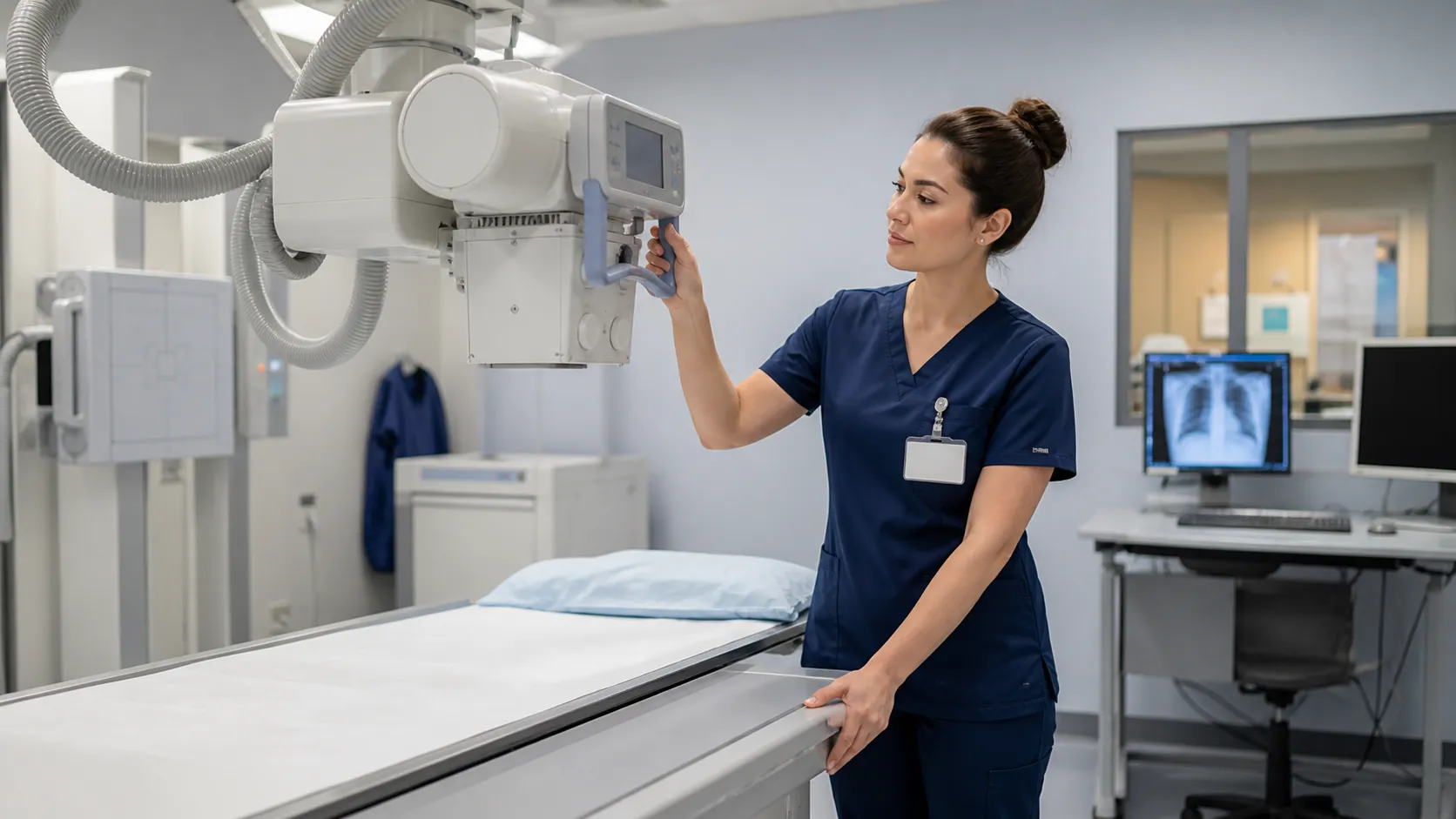
The American Registry of Radiologic Technologists (ARRT) Radiography examination covers patient care, radiation physics and protection, image production, equipment, quality assurance, anatomy, and positioning. ARRT describes its purpose as assessing the knowledge and cognitive skills needed for intelligent performance of entry-level staff-technologist tasks. That includes both factual knowledge and applying it to clinical situations.
Verified 2025 Result
ARRT's 2025 Annual Exam Report lists a first-attempt Radiography pass rate of 85.8% among 14,070 first-time candidates. That is a one-year result, not a guaranteed personal probability, and ARRT does not attribute unsuccessful attempts to one particular study habit.
Eligibility Before Exam Day
For the primary eligibility pathway, passing the exam is only one part of earning the credential. A candidate must satisfy ARRT's education, ethics, and examination requirements. The current education rules require completion of an ARRT-verified Radiography educational program, including the required didactic and clinical competencies, plus an associate degree or higher in any subject from an institution accredited by an agency ARRT recognizes. The degree must be conferred before the candidate sits for the exam. Candidates may apply no more than three months before expected program completion and must earn the degree and apply within three years after completing the program. They should follow their own Candidate Status Report for their assigned dates.
Applicants and registrants must comply with the ARRT Standards of Ethics and disclose potentially reportable conduct as ARRT directs. Candidates concerned that prior conduct could affect eligibility can review ARRT's optional ethics review preapplication process. ARRT certification does not itself guarantee authority to work in every state; state licensure requirements vary and must be checked separately.
Current Radiography Exam Blueprint
For exams administered through February 28, 2027, the official content specifications publish 200 scored questions in four major categories. Each exam also contains 30 unscored pilot questions, for 230 questions presented in total. Pilot questions are mixed into the exam, are not identified, and do not affect the score.
| Major content category | Scored items | Published subcategories |
|---|---|---|
| Patient Care | 33 | Patient Interactions and Management (33) |
| Safety | 50 | Radiation Physics and Radiobiology (21); Radiation Protection (29) |
| Image Production | 51 | Image Acquisition and Evaluation (26); Equipment Operation and Quality Assurance (25) |
| Procedures | 66 | Head, Spine and Pelvis (18); Thorax and Abdomen (20); Extremity (28) |
| Total | 200 | Plus 30 unscored pilot questions |
Blueprint insight: Procedures and Safety account for 116 of the 200 scored items (58%). That makes them large study areas, but no category should be ignored. Equipment Operation and Quality Assurance is a 25-item subcategory of Image Production, not a fifth major category.
An Adaptable 8-Week Study Framework
Eight weeks is an example framework, not an ARRT requirement or a proven schedule for everyone. Adjust the pace to your baseline knowledge, program guidance, work obligations, and exam date. Start by downloading the current Radiography Examination Content Specifications and use every published line as a checklist.
Weeks 1-2: Physics, Safety, and Image Production
Review x-ray production, photon interactions, radiobiology, dose units, radiation protection, exposure-factor relationships, digital receptors, processing, artifacts, equipment, and quality assurance. Avoid the film-era shortcut that “kVp controls contrast and mAs controls density.” In digital radiography, mAs strongly affects receptor exposure and quantum noise; kVp affects beam quality, penetration, subject contrast, and receptor exposure, while displayed brightness and contrast are also influenced by processing.
Weeks 3-5: Procedures
Work body region by body region from the official Attachment A. For each listed position or projection, review:
- Patient and part position — how the anatomy is placed relative to the image receptor
- Central-ray path — direction, angle, and centering
- Anatomy demonstrated — the structures expected on the image
- Image evaluation — positioning, alignment, exposure, artifacts, and when correction or repeat may be justified
- Adaptation — trauma, pathology, age, body habitus, and limited mobility
Weeks 6-7: Retrieval Practice and Corrections
Use a manageable number of reputable practice questions and review the rationale for every uncertain or incorrect response. A major evidence review rated practice testing and distributed practice as high-utility learning techniques, but it did not establish an ARRT-specific question quota or passing outcome. Keep an error log tied to the official blueprint. Question volume alone is not evidence of readiness; ARRT's handbook sets no daily question quota and does not endorse a commercial question bank.
Week 8: Timed Rehearsal
Use one or more timed mixed-topic rehearsals if that helps your pacing. The standard Radiography exam provides 230 minutes for 230 total questions; approved accommodations can change an individual's timing. A practice percentage is not an ARRT scaled score, so no commercial-test percentage guarantees a pass. Use performance patterns to choose what to review, protect sleep, and confirm your appointment and identification.
Published Topics Worth Practicing
Inverse Square Law
Intensity varies inversely with distance squared. If distance from a point source doubles, intensity at that location becomes one quarter, assuming other conditions are unchanged.
Chest Procedures
The official list includes PA or AP upright, lateral upright, AP lordotic, AP supine, and lateral decubitus chest work. Review positioning and evaluation; our chest X-ray interpretation guide is supplementary.
Grids
Review scatter cleanup, grid ratio, grid-conversion factors, alignment errors, and dose optimization. When a grid change requires higher mAs to maintain receptor exposure, patient dose generally increases.
Fluoroscopy
Review both image-intensifier and flat-panel systems, ABC/AERC, magnification, positioning, pulsed operation, dose displays, last-image hold, and fluoroscopic radiation protection.
These topics appear in ARRT's public specifications; that does not mean every candidate will receive a particular narrow-topic question. ARRT publishes counts only at the category and subcategory levels shown above.
Scheduling and Test-Day Rules
ARRT supplies an online Candidate Status Report after processing the application. It shows the candidate's ARRT ID, three-year eligibility period, and assigned exam window. The current primary-pathway handbook describes a one-year exam window and says candidates can schedule with Pearson 24 hours after receiving the report. Appointments fill, so schedule early and follow the report's instructions. Pearson charges a fee each time an appointment is rescheduled. Online cancellation or rescheduling must be completed at least 24 hours before the appointment; by phone, it must be completed at least one business day before the appointment, and weekends and national holidays do not count as business days.
- Timing: Radiography has 230 minutes of test time for 230 questions. The 2026 handbook's Radiography table gives a standard appointment of 250 minutes (4 hours 10 minutes), including an 8-minute tutorial, 2-minute nondisclosure agreement, and 10-minute survey. ARRT's general “Taking the Exam” webpage currently says 18 minutes for the tutorial, so follow the time shown on your current Candidate Status Report and Pearson confirmation.
- Arrival: arrive at least 30 minutes before the appointment. Arriving 15 minutes or more late can result in forfeiture of the appointment and application fee.
- Identification: bring two valid, unexpired, acceptable IDs. The primary ID must be government-issued and include the permanently printed name, photo, and signature or military bar code; the secondary must include the permanently printed name and signature. Names must match the Candidate Status Report under ARRT's stated middle-name rules.
- Calculator: do not bring a personal calculator. Basic and scientific calculators are available on screen; Pearson can provide a basic four-function handheld calculator on request.
- Answer and review: the computer requires an answer before moving forward. Guess if needed, flag the item, and return if time remains. ARRT says the score is based on the number of correct answers, so it is in the candidate's best interest to answer every question.
- Security: personal items, notes, study guides, phones, electronic devices, and personal calculators stay outside the test room. Do not share recalled exam questions or answer options.
Scoring, Results, Fees, and Retakes
ARRT uses a 1-to-99 scaled-score range; 75 is passing. A 75 is not 75% correct. The raw number needed can vary with exam-form difficulty. At the end of the exam, the candidate sees a preliminary scaled score on screen. It is not final, cannot be printed, and cannot be retrieved after leaving that screen. ARRT says official results are normally posted to the online account within about 10 business days.
The current fee for a primary-pathway Radiography application is $225. Fees can change, and reapplication/rescheduling costs may also apply, so verify the current ARRT fee page and Pearson terms before paying.
A candidate has up to three attempts within three years from the opening date of the first exam window. Eligibility ends after three unsuccessful attempts or when the three years expire, whichever comes first. An attempt made as a state licensing candidate counts toward ARRT's three-attempt limit if the person also applies for ARRT certification and registration in that discipline. After a first or second unsuccessful attempt, the candidate must reapply and pay the required fee. After reaching the limit, a primary-pathway candidate must regain eligibility by enrolling in and completing the same or a different ARRT-recognized educational program in the discipline.
Study Resources Without Endorsement
ARRT explicitly says it does not recommend or endorse review programs, mock registries, study guides, or textbooks. Use the official specifications as the scope document. Then use current program materials, a current positioning reference, and reputable practice resources selected with your instructors or program director. Examples such as Mosby's, Lange, Bontrager, Merrill's, or commercial question banks may be useful to some learners, but they are third-party products and are not ARRT-approved or guaranteed to reproduce the exam.
After Certification: Ongoing Requirements
Earning the credential is not the last requirement. ARRT requires annual renewal, biennial continuing education, and—where applicable—Continuing Qualifications Requirements. Most R.T.s must complete 24 approved CE credits per biennium regardless of how many ARRT credentials they hold. Deadlines and special rules can differ, so registrants should check their ARRT dashboard and the current CE requirements.
Official Sources
- ARRT 2026 Primary Eligibility Pathway Handbook
- ARRT Radiography Examination Content Specifications—through February 28, 2027
- ARRT: Taking the Exam and Exam Scoring
- ARRT: Three Attempts in Three Years
- ARRT: Radiography credential documents and effective dates
- ARRT: Primary Requirements
- ARRT: Application Fees
- ARRT: Biennial Continuing Education Requirements
- ARRT Annual Exam Report—2025
- IAEA: Diagnostic Radiology Physics: A Handbook for Teachers and Students (exposure factors, inverse-square law, digital imaging, and grids)