X-Ray Production: Bremsstrahlung & Characteristic
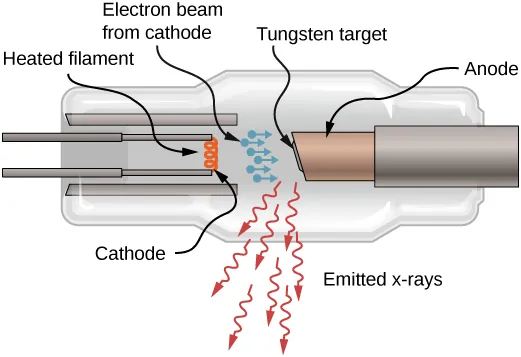
Every X-ray image starts in one place: the X-ray tube. Understanding exactly how X-rays are produced — from the moment the exposure button is pressed to the instant photons exit the tube port — is the foundation of radiographic physics. This article breaks down the two mechanisms of X-ray production, the components involved, and the spectrum of energies that result.
Key Concept
At the anode, energetic electrons undergo many interactions. Deflection or slowing in nuclear electric fields produces Bremsstrahlung; shell ionization followed by electronic transitions produces characteristic X-rays. At diagnostic voltages, roughly 1% or less of the electron power becomes X-radiation and nearly all the rest becomes heat; this ratio is an approximation that varies with tube voltage and target atomic number.
The X-Ray Tube: A Quick Overview
Before we dive into how X-rays are produced, let's review the hardware that makes it happen. The X-ray tube is a vacuum-sealed glass or metal envelope containing two main electrodes:
Cathode (−)
Contains the filament (usually tungsten wire) that produces electrons via thermionic emission when heated. Also has a focusing cup to direct the electron stream toward the anode.
Anode (+)
Target surface (tungsten or tungsten-rhenium alloy) where electrons impact. Rotating anodes dissipate heat across a larger area. The angle of the target face affects focal spot size.
Envelope & Housing
The evacuated glass, ceramic, or glass-metal envelope lets electrons travel from cathode to anode without substantial gas collisions. The shielded housing limits leakage radiation, and insulating oil also transfers heat.
The Two Mechanisms of X-Ray Production
When electrons strike the anode, X-rays are produced through two distinct physical processes. Both happen simultaneously inside the tube. Understanding the difference is essential for mastering X-ray physics and image optimization.
1. Bremsstrahlung Radiation ("Braking Radiation")
Bremsstrahlung (pronounced brehm-strah-lung) is German for "braking radiation." It is the major spectral component in general diagnostic radiography. A universal photon percentage should not be assigned: the bremsstrahlung/characteristic balance varies with tube voltage, target, filtration, and whether photon fluence or energy fluence is being compared. The IAEA notes that tungsten K radiation contributes less than 10% of total energy fluence even at 150 kV.
How It Works
When a high-speed electron passes near the nucleus of a tungsten atom:
- The electron is attracted by the strong positive charge of the nucleus
- Its path is deflected (bent), causing it to slow down
- The lost kinetic energy is emitted as an X-ray photon
In the simplified model, a closer encounter generally produces greater deflection and can transfer more energy to one photon. Across many stochastic interactions this creates a continuous spectrum. A single electron can emit anything from a low-energy photon to, in the limiting case, a photon carrying almost all of its kinetic energy; a nuclear "direct hit" is not required.
ARRT Tip
For an ideal 80 kVp exposure, the electron endpoint energy is 80 keV and the nominal bremsstrahlung endpoint is therefore 80 keV (the numerical equality is between photon energy in keV and peak potential in kV). The beam's mean energy is not a fixed percentage of kVp; it depends strongly on filtration and also on the voltage waveform, target, and geometry.
2. Characteristic Radiation
Characteristic radiation produces X-ray photons at specific, discrete energies determined by differences between the target atom's shell binding energies. In a filtered general-radiography tungsten spectrum, the prominent K lines lie at approximately 58-69 keV.
How It Works
- An incoming electron has enough kinetic energy to eject a bound electron (for the prominent tungsten K lines, a K-shell electron)
- This leaves a "hole" or vacancy in the K-shell
- An electron from an outer shell (L-shell, M-shell) drops down to fill the vacancy
- The energy difference between shells is released as an X-ray photon with a specific energy
Characteristic Radiation Energies for Tungsten
| Transition | Energy (keV) | Common Name |
|---|---|---|
| LIII → K / LII → K | 59.32 / 57.98 | Kα1 / Kα2 |
| MIII → K / NIII → K | 67.24 / 69.07 | Kβ1 / Kβ2 |
When Does Characteristic Radiation Occur?
Tungsten K-characteristic radiation requires an incident electron with energy above the K-shell binding energy, about 69.5 keV. A peak tube potential above about 69.5 kV permits those interactions, although electrons have a range of instantaneous energies. This is not a threshold for all characteristic radiation: tungsten L-shell vacancies and L lines can occur at lower energies, but those low-energy photons are absorbed by typical 2.5 mm Al-equivalent general-radiography filtration. Above the K threshold, K lines appear at their fixed energies.
The X-Ray Emission Spectrum
The X-ray emission spectrum plots a stated spectral quantity—commonly photon fluence per energy interval—against photon energy in keV. It describes the energy distribution, but beam quality is also summarized clinically by measures such as half-value layer (HVL), and spectrum alone does not specify image quality or patient dose.
Reading the Spectrum
Schematic 100 kVp filtered tungsten spectrum (not to scale): smooth bars = Bremsstrahlung continuum; orange bars near 59 and 67 keV = grouped Kα and Kβ lines.
The spectrum reveals three important facts:
- Low-energy suppression — self-filtration, the tube window and housing components (inherent filtration), and added filtration preferentially remove low-energy photons; the exact low-energy shape is filtration dependent
- Endpoint — the bremsstrahlung continuum ends at the maximum electron energy; its shape and most-probable/mean energies are not fixed percentages of kVp
- Sharp lines — characteristic lines are superimposed at fixed target-specific energies; prominent tungsten K lines require electrons above the approximately 69.5 keV K-shell threshold
What Changes the Spectrum?
| Adjustment | Effect on Spectrum |
|---|---|
| Increase kVp | Raises the endpoint energy and generally increases photon output and mean energy. Characteristic-line energies stay fixed, although their production can begin after a shell threshold is crossed. |
| Increase mAs | At unchanged kVp, waveform, filtration and geometry, increases photon fluence approximately in proportion to mAs while leaving the normalized energy distribution essentially unchanged. |
| Add filtration | Preferentially removes low-energy photons, lowers total output, and raises mean energy and HVL (beam hardening) without changing the kVp endpoint. Proper filtration reduces unnecessary entrance dose; maintaining receptor exposure may require more mAs. |
| Reduce anode angle | Generally increases self-absorption and the heel effect and limits field coverage. The anode side has lower intensity and, because lower-energy photons are preferentially absorbed in the target, a harder—not softer—spectrum. |
Why Does Nearly All the Energy Become Heat?
At diagnostic energies, approximately 1% or less of electron power converts to X-radiation and nearly all the remainder heats the anode. The fraction is not constant: bremsstrahlung efficiency increases with tube voltage and target atomic number (the IAEA gives about 0.8% at 100 kV for tungsten). This low efficiency is why:
- Tungsten is used for many general-radiography targets because its high atomic number improves bremsstrahlung yield and its high melting point (about 3,422°C for pure tungsten) supports heavy heat loading; other target materials are used for tasks such as mammography
- Rotating anodes commonly operate at about 3,000-3,600 or 9,000-10,000 revolutions per minute to spread energy over a larger focal track
- Many rotating-anode designs use a tungsten-rhenium focal track with a molybdenum, graphite, or composite anode body; construction varies by tube design
- Insulating oil around the tube insert transfers heat from the envelope to the housing and cooling system
Heat vs. X-Rays — A Useful Analogy
Unlike an incandescent lamp, useful X-rays are not thermal glow from the hot filament or anode. The filament's heat releases electrons by thermionic emission; high voltage accelerates them; their interactions in the target generate X-rays, while most deposited energy becomes unwanted heat. You can explore the X-Ray modality page for more on clinical applications.
Putting It All Together: The Full Production Chain
- Filament current heats the cathode filament to roughly 2,700 K (about 2,400°C in the IAEA's representative description), producing thermionic emission
- Tube voltage accelerates electrons from cathode to anode; their maximum kinetic energy in keV is numerically equal to the applied potential in kV (at 80 kV, maximum speed is about 0.50c)
- Electron impact — electrons strike the target (commonly a rotating tungsten-rhenium target in general-purpose high-output tubes; some systems use stationary or other target designs)
- Bremsstrahlung — electrons deflected or slowed in nuclear electric fields produce the continuous, usually dominant spectrum
- Characteristic — shell ionization and vacancy filling produce discrete lines; tungsten K lines require electron energies above about 69.5 keV
- Filtration — inherent and added filtration preferentially remove low-energy photons, reducing unnecessary entrance dose; technique may need adjustment to maintain receptor exposure
- Collimation — lead shutters shape the beam to the anatomy of interest
- Exit port — the useful X-ray beam emerges through the tube housing window
Key Takeaways for the Registry
- Bremsstrahlung = continuous spectrum and usually the major component in a filtered, general-radiography tungsten beam; the exact fraction is technique and metric dependent
- Characteristic radiation = discrete target-specific energies; only tungsten K lines have the approximately 69.5 keV production threshold (lower-energy L lines are normally removed by general-radiography filtration)
- Endpoint photon energy in keV is numerically equal to peak tube potential in kV (at 90 kVp, the nominal endpoint is 90 keV)
- Mean photon energy has no fixed kVp percentage; filtration, voltage waveform, target and geometry all matter
- About 1% or less X-radiation at diagnostic voltages — nearly all electron power becomes heat, and efficiency varies with kV and target atomic number
- Filtration hardens the beam by removing low-energy photons
For more on how these physics principles translate to image quality, read our guide to X-Ray Physics Made Simple: kVp, mAs, Density, and Contrast.
Authoritative Sources
- IAEA, Diagnostic Radiology Physics: A Handbook for Teachers and Students, Chapter 5 (X-ray production, spectra, tubes, heel effect, and filtration).
- NIST X-ray Transition Energies Database: tungsten (K-edge and individual K-line energies).
- OpenStax University Physics, “Atomic Spectra and X-rays” (continuous and characteristic X-ray production).
- U.S. FDA, Medical X-ray Imaging (radiation-protection and optimization context).